Updated on July 3, 2025
In plastic molding processes, extrusion, injection molding, and blow molding represent the three most fundamental technologies, each exhibiting significant differences in principles, suitable products, efficiency, and costs. Below is a comprehensive comparative analysis:
🧪 1. Principles and Process Flow
1.Injection Molding
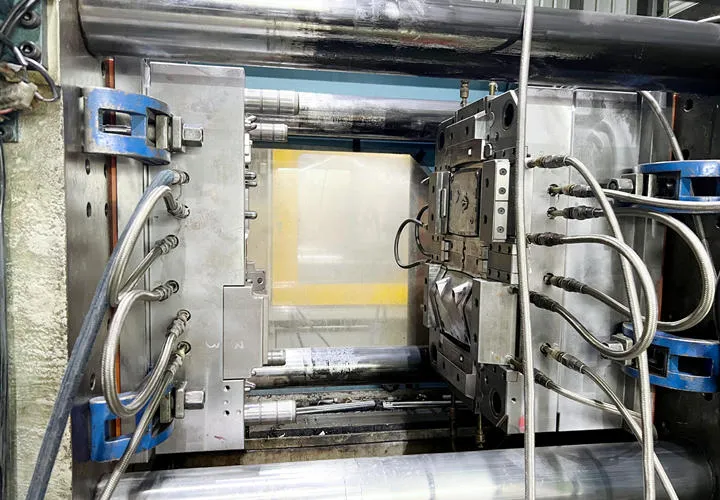
- Principle: Plastic pellets are melted and injected under high pressure (60-130 MPa) into a closed mold cavity. After cooling, the solid part is ejected.
- Process: Material drying → Melting → High-pressure injection → Cooling → Demolding.
- Key Features: Ideal for complex geometries (e.g., parts with inserts), high precision (±0.01–0.03mm), but requires expensive molds (10K–1M) and has longer cycle times (30–120 seconds/part).
2.Extrusion Molding
- Principle: Melted plastic is continuously pushed through a die via a rotating screw (10–200 RPM) to form linear profiles (e.g., pipes, sheets).
- Process: Melting → Screw extrusion → Die shaping → Cooling/cutting.
- Key Features: Continuous production (5–20 meters/minute), low-cost molds (
1K–10K), but limited to uniform cross-sections with lower precision (±0.5mm; minimum wall thickness ≥0.5mm).
3.Blow Molding
- Principle: A molten parison (tube or preform) is inflated with compressed air (0.5–1.0 MPa) against a mold to create hollow parts.
- Variants:
- Extrusion Blow Molding (EBM): Direct parison extrusion for large containers (e.g., 30L fuel tanks); 5–15% scrap from trimming.
- Injection Blow Molding (IBM): Preforms are injection-molded first, enabling high precision (±0.02mm) for small bottles (<300ml).
- Stretch Blow Molding (SBM): Biaxial stretching enhances strength (e.g., PET bottles; wall thickness 0.2–5mm).
- Key Features: Specialized for hollow parts; EBM cycles in 10–60 seconds; IBM/SBM require complex tooling.
🏭 2. Product Types and Applications
| Process | Typical Products | Applications |
|---|---|---|
| Injection Molding | Electronics housings, gears, thin-wall containers | Automotive dashboards, medical devices |
| Extrusion | Pipes, window frames, multilayer films | Construction, packaging, rail seals |
| Blow Molding | Beverage bottles (SBM), industrial tanks (EBM), cosmetic bottles (IBM) | Food packaging, automotive fuel systems |
📊 3. Key Performance Comparison
| Aspect | Injection Molding | Extrusion | Blow Molding |
|---|---|---|---|
| Geometry | Complex 3D solids (with inserts) | Linear profiles (fixed cross-section) | Hollow parts (variable wall thickness) |
| Precision | ±0.02mm | ±0.5mm | EBM: ±0.5mm; IBM: ±0.02mm |
| Speed | 30–120 sec/cycle | 5–20 meters/minute | EBM: 10–60 sec/cycle; IBM: slower |
| Cost | High mold cost (10K–1M) | Low tooling cost (1K–10K) | EBM: 5K–20K molds; IBM: higher |
| Material Use | Most thermoplastics; ≤30% recycled | PVC/PE/PP; ≤50% recycled | HDPE (EBM), PET (SBM); ≤10% recycled for food-grade |
| Scrap Rate | 2–5% | 1–3% | EBM: 5–15% (trimming) |
🧪 4. Material Compatibility
- Injection Molding: High-fluidity resins (ABS, PC, PA); thin walls require MFI >10g/10min.
- Extrusion: Needs high melt strength (e.g., PVC with stabilizers); multilayer dies enable barrier layers (EVOH).
- Blow Molding: EBM uses HDPE (MFI 0.04–1.12); SBM relies on PET’s stretchability.
✅ 5. Selection Guidelines
- Choose Injection Molding For:
- High-precision, complex parts (gears, threaded caps) and mass production (>100K units).
- Advantage: Excellent dimensional stability; supports metal inserts.
- Choose Extrusion For:
- Continuous profiles (pipes, films) and cost-driven production (e.g., 5K tons/year construction materials).
- Advantage: Energy-efficient; high recycled content compatibility.
- Choose Blow Molding For:
- Hollow containers: EBM for large/low-cost (>1L); IBM/SBM for small/high-precision (e.g., pharma bottles).
- Note: EBM requires trimming allowance; SBM needs controlled stretch ratios.

💎 Summary
These processes are complementary in plastics manufacturing:
- Injection Molding: Dominates precision parts (automotive/electronics).
- Extrusion: Leads in continuous production (construction/packaging).
- Blow Molding: Unmatched for hollow products (bottles to industrial tanks).
Selection Criteria:
- Design: Complexity (3D → injection molding), uniformity (linear → extrusion), hollowness (→ blow molding).
- Economics: Low-volume → extrusion/EBM; high-volume → injection molding/IBM.
- Material: Flowability (injection molding> extrusion > blow molding), melt strength (extrusion > blow molding > injection).
Trends: Injection molding evolves with multi-color/microcellular foaming; extrusion advances co-extrusion; blow molding targets flash-free molds.
The following is the original text, published on July 14, 2017
A little late to add anything about the difference between extrusion and injection molding, blow molding, but I want to add a practical market view including the factors of how much the molds cost and how many items are wanted.
Extrusion is a continuous process used to make sheet, pipe and profiles, film and coating, wire covering, filaments and fibers, feeding blow molders, and mixing/making pellets for other processes, including injection molding. Continuous extrusion dominates these markets — there are ways to extrude into a closed mold, perhaps useful for low-volume applications. Almost all injection molding really does this, too, using a screw to melt the material, and then as a piston to force the melt into the mold. However, these processes are always called “injection,” and the use of the phrase “extrusion molding” is confusing without further explanation.
Basically, injection FILLS molds, blow molding (and sheet thermoforming) draws material to the mold surfaces. As a result, injection molds need to take much more pressure and are therefore much more expensive.
Injection-blow molding is a process that always existed for small containers but has grown because of PET beverage containers; in this process, preforms are injected, then usually reheated, stretched for greater strength, and blown out into molds. Most of these preforms are made by straight injection molding in very large and very expensive multiple-cavity molds, which become economical because of the huge volumes of these products on the market. Preforms can also be made by a combination of partial injection and compression (first seen as Dynaplast Co-Blow at the 1978 K show), which allows lower melt temperatures and corresponding advantages for PET food/beverage packaging. It also may allow lower mold costs, and thus be preferable in low-volume applications which don’t run 24/7 for weeks or months at a time with the same product.
All the above relate to thermoplastics. Thermosets (phenolics, epoxies, some urethanes, certain polyesters) are another world, may be compression molded, transfer molded, injected, even processed continuously (pultrusion). They use different materials and usually serve different markets, seldom competitive with thermoplastics.