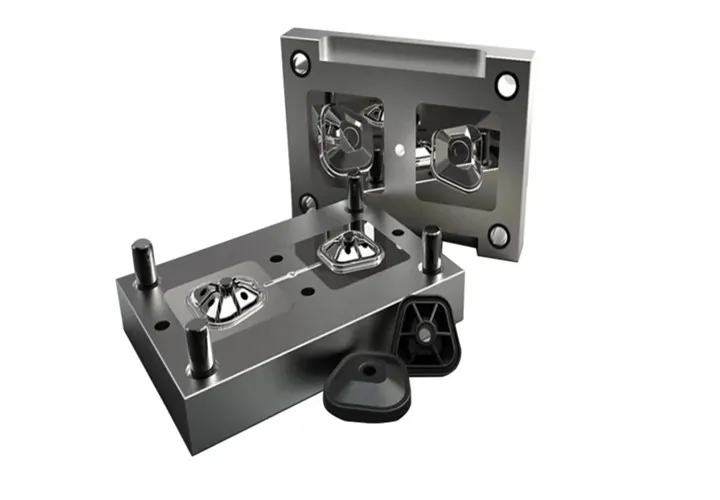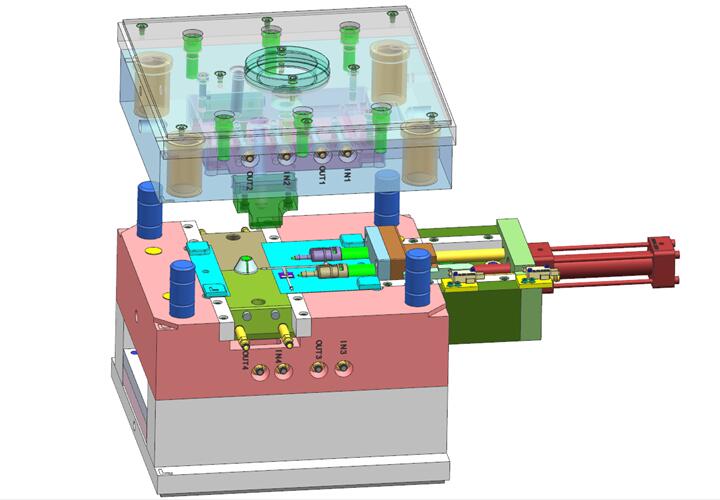
When the hot material is injected into the cavity it will shrink as it cools down (Pressure /Volume/Temperature or PvT diagrams will show you this). For that reason a pressure is applied to compress material and “force” it into the cavity to compensate for this shrinkage. As this pressure sort of squeezes the molecules together you will build up some stress inside the material. And in worst case this can lead to weaker parts or cracks in the product later on.
When using compression molding the cavity is slightly open when injecting and thus has more room for material. This way all the needed material can be injected rapidly into the cavity and instead of applying pressure in the material the mold clamps and thereby closes the cavity to the intended size (or volume). This reduces the internal stress in the part as you can image the molecules finding their own space so to say. Compression molding is very useful in thin wall parts to better be able to fill the part during injection and optical parts where stress will disturb the optical quality of the part, that’s the pros.
However many beverage caps use continuous rotary compression molding which is altogether a different process. We used this process at a company I worked at for 35mm film cans and covers and it can be hypnotic to watch it run at full speed. If you look at a beverage cap and there is no indication of a gate mark on the part, it was most likely compression molded.
Compression molding requires a continuous rotary compression molding machine which extrudes material through a die, cuts off the extrudate, transfers the extrudate (looks like a big pellet) into the cavity, the cavity closes and compresses the material as move around a big wheel. Parts cool on the wheel, get unloaded (part orientation is maintained a boon to downstream operations) and then the process repeats.
We also injection molded a lot of film cans and covers over the years and were cost effective with both processes. If all you know is injection molding and you want all your plants around the world to use the same process, then perhaps sticking with injection molding makes sense, but I would take a hard look at the bottom line before making that decision.
If you are willing to bring a new process on board I think you will find the compression molding process to be very cost effective.
Also, the compression molding process allows you to use a higher molecular weight material (a low melt flow material) which will provide higher mechanical properties than a lower molecular weight material. The compression molding process doesn’t have a long flow path which requires the low viscosity injection molding grade of material.
There are limitations to the process, as there are with any process. You would want the experts to review your product design and make sure it is a robust design for compression molding. You will have to learn a new process (fun for the engineers out there.) You may have to train your mechanics to repair a different machine.