Abstract: This article elaborates on the techniques and key points related to the parting line in mold design. It initially defines the closing line and parting line and highlights their significance. Subsequently, it focuses on the precautions in designing the parting surface, encompassing position selection, the relationship with the product’s appearance and functionality, the impact on crucial size mechanisms, the handling of dead-end areas in the plastic molded product, and cost considerations. It also introduces similar concepts in different mold types, the relationship of the parting line in multi-cavity molds, and innovative design concepts.
I. Definition of the Closing Line and Parting Line in Injection Molding
What are the closing line and parting line?
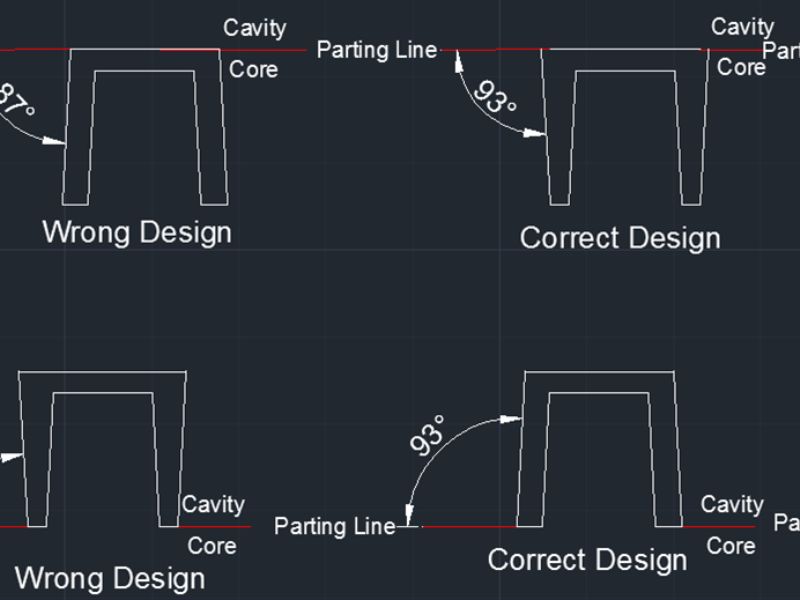
During the injection molding process of plastic parts, since the parts need to be formed in several sections and then assembled together to form a closed space, the line between each section is the injection molding parting line. The parting line is typically an entire surface on the mold; thus, in mold making or 3D drawing, it is often referred to as the “parting surface” or “split surface“.
After the plastic injection molding is completed, the molded product must be removed from the mold. If the mold cannot be opened, it will be impossible to extract it. Therefore, a set of plastic molds must be divided into upper and lower or left and right molds. The gap that emerges where the molds are separated or combined is known as the closing line or parting line in the plastic industry.

The Importance of Parting Line in Product Design and Mold Design
The determination of the injection molding parting line is highly significant in product design and mold design. It not only relates to the molding and demolding processes of the product but also influences its appearance and aesthetics. From a mechanical perspective, the position of the parting line affects the force distribution during the opening and closing of the mold, thereby influencing the demolding effect of the product. Regarding material flow, the setting of the parting line influences the flow path and filling effect of the plastic melt in the mold cavity, thereby affecting the quality and performance of the product.
The design of the parting line often occurs at the chamfered edges of the part or the highest point of the part to facilitate demolding and enhance aesthetics. The position of the parting line is often where two parts meet. Designers can increase the diversity and aesthetics of the design by designing different colors and materials for the two parts. Therefore, as a proficient designer, one must master the basic principles of the parting line to fully express good creativity and utilize the parting line to elevate the product design to a higher level of aesthetics.
II. Precautions in the Design of the Parting Surface
1.Position selection of the parting surface
It is advisable to design the parting surface along the corners or edges of the plastic molded product. Even if there are some minor burrs, they are less likely to be noticed. The advantage of this design lies in that the corners and edges are usually not the main observation areas of the product. At these positions, the opening and closing actions of the mold are relatively stable, reducing the impact on the product’s appearance. For instance, for a cylindrical plastic product, setting the parting surface at the two bottom edges of the cylinder is less conspicuous than setting it on the side. Moreover, different mold materials also have an impact on the accuracy of the closing line.
For example, using a mold material with higher hardness can reduce the mold’s wear to a certain extent and maintain the accuracy of the closing line, but the cost may increase accordingly. Therefore, it is necessary to comprehensively consider the product requirements and costs when selecting the appropriate mold material.
2.Relationship between the parting surface and the appearance and functionality of the product
It is best to avoid placing the parting surface where there are appearance requirements. If it must appear on the appearance surface, try to position it in an inconspicuous area. At the very least, texture should be employed to minimize the adverse impact on the appearance caused by the closing line. For example, when designing the shell of a mobile phone, the closing line should avoid the screen display area or the parts frequently held and observed by the user. Additionally, the position and processing method of the closing line also affect the functionality of the product. For instance, for products that need to have waterproof performance, the processing of the closing line must be exceptionally precise to ensure the sealing effect.

3.Relationship between the parting surface and crucial size mechanisms
If there is a position of a crucial size mechanism, it is preferable to avoid designing it as a parting surface because the size of the parting surface is not easily controlled. Common crucial size mechanisms include precisely fitted shaft holes and key installation positioning surfaces. If these components are located on the parting surface, due to errors in mold manufacturing and assembly, it may lead to difficulties in guaranteeing dimensional accuracy and affect the assembly performance of the product. In actual production, we also need to pay attention to the standards and specifications for the design of the closing line within the industry. There are relevant standards both domestically and internationally. Adhering to these standards can ensure the stability of product quality and promote the healthy development of the mold manufacturing industry.
4.Relationship between the parting surface and the dead-end areas of the plastic molded product
When there are dead-end areas in the plastic molded product, the mold for this part should be thoroughly considered. For such situations, special structures such as sliders and angled ejectors can be utilized to achieve the smooth opening and closing of the mold and the demolding of the product. Alternatively, optimize the product structure in the design stage to avoid the emergence of dead-end areas that are difficult to demold. Simultaneously, the design and processing of the closing line are closely related to the service life of the mold. A reasonable closing line design can reduce the mold’s wear and stress concentration, extend the mold’s service life, and reduce production costs.
5.Post-processing and cost of the parting surface
Sometimes when the parting surface is challenging to handle, it is possible to use the post-processing method to grind and remove it, but this will increase the product’s cost. It should be noted that post-processing not only raises the cost but also may impact the production efficiency and consistency of the product. Therefore, the design of the parting surface should be optimized at the mold design stage as much as possible to minimize the need for post-processing. A detailed calculation and analysis of the additional production costs caused by an improper design of the closing line, such as post-processing costs and increased scrap rates, will make us more acutely aware of the significance of optimizing the design of the closing line.
III. The Concept of the Parting Line in Different Types of Molds
In addition to plastic molds, are there similar concepts of the parting line in other types of molds, such as die-casting molds and stamping molds?
In die-casting molds, it is typically referred to as the parting line. In stamping molds, it is called the cutting line or separation line. Although their names and specific applications differ, the principles and design considerations exhibit certain similarities. With the development of the mold industry, new types of plastics or composite materials continue to emerge. When these emerging materials are molded, the parting line may present different characteristics, posing new challenges to the design. For example, some composite materials have poor fluidity and require more meticulous design of the parting line to ensure uniform filling of the mold cavity.
IV. The Relationship of the Parting Line in Multi-Cavity Molds
How to handle the relationship of the parting line between different cavities in multi-cavity molds?
It is necessary to ensure that the position of the parting line of each cavity is reasonable to avoid mutual interference and simultaneously guarantee the consistency of the quality of the parting line of each product in the multi-cavity mold. This requires comprehensive consideration and planning at the initial design stage.
V. Innovative Design Concepts of the Parting Line
What are the innovative design concepts of the parting line?
Innovative design concepts of the parting line are constantly emerging. For example, cutting-edge design methods such as seamless parting and hidden parting have brought new breakthroughs to the product’s appearance and performance. However, these innovative designs may also have potential issues in practical applications, such as increased processing difficulty and higher costs, which need to be comprehensively weighed during the design process.

VI. Conclusion
The parting line is of crucial importance in mold design. When designing the parting surface, note that the position should preferably be at the corners or edges to avoid affecting the appearance and demolding; avoid it where there are appearance requirements. If necessary, position it in an inconspicuous area and apply fading treatment; avoid setting it at positions of crucial size mechanisms; fully consider the mold design for dead-end areas of the plastic molded product; minimize post-processing and optimize the design to reduce costs.
ACO Mold Company, in its long-term business practice, has deeply studied and applied these parting line design principles and provided numerous high-quality and high-precision mold products to customers. We deeply understand that only by fully considering these factors, conducting reasonable design and optimization, can we enhance product quality, reduce costs, and promote the continuous advancement of mold design technology.