Acetal vs Delrin for Injection Molding – Choosing the Right Material
Abstract: Injection molding is the linchpin of modern manufacturing for producing high – precision plastic parts. However, the success of your project hinges on choosing the right material, such as Acetal or Delrin. When dealing with tight tolerances, undercuts, or complex mold systems, the material you select can have a profound impact on the outcome. This guide will delve into how Acetal and Delrin compare in aspects like mold types, part release, cooling, and shrinkage control. Whether you’re working with a two – plate mold or grappling with undercut designs, this breakdown will assist you in making the optimal choice for your injection – molding project.
What Are Acetal and Delrin?
In the realm of injection molding and part manufacturing, the terms Acetal and Delrin frequently surface. Both materials belong to the same polymer family, yet they possess distinct properties that render them suitable for different applications. This article aims to provide you with a comprehensive understanding of these materials, comparing their properties, uses, and roles within the injection – molding process.
Acetal (POM) Overview
Acetal, chemically known as Polyoxymethylene (POM), is a high – performance thermoplastic. Renowned for its strength, stiffness, and low friction, it is an ideal choice for precision parts and components that demand dimensional stability. Acetal finds extensive use in various industries, including automotive, medical, and industrial sectors.
Properties of Acetal (Polyoxymethylene)
Acetal exhibits excellent chemical resistance, making it well – suited for environments where exposure to oils, solvents, and other chemicals is common. Its dimensional stability ensures that parts maintain their shape and size over time, even under fluctuating temperature conditions. The material also boasts remarkable fatigue strength, a crucial attribute for applications where parts are subjected to repeated stress. In tool – room applications, Acetal is a reliable material for parts that need to endure repeated mechanical cycles, often being used in gears, bearings, bushings, and other components that require precision and strength.
Delrin Overview
Delrin is a branded form of Acetal, specifically a homopolymer version manufactured by DuPont. It represents a more refined iteration of Acetal, characterized by higher crystallinity, which confers enhanced mechanical strength. While both materials are part of the same family, Delrin is often regarded as superior due to its improved properties.
Unique Traits of Delrin
Delrin stands out for its superior mechanical properties in comparison to standard Acetal. With its higher crystallinity, Delrin offers greater strength, rigidity, and wear resistance. Additionally, it has lower moisture absorption, contributing to more stable dimensional characteristics in humid environments. Delrin is highly favored in undercut plastic injection molding, where it can adeptly handle the formation of complex, precise geometries. Its mechanical strength and ease of machining make it ideal for precision parts such as automotive gears, electrical components, and certain medical devices.
Acetal vs Delrin – A Basic Comparison

Grasping the difference between Acetal and Delrin is fundamental for selecting the appropriate material for your project. The following is a basic comparison of both materials:
Material Formulation Differences
Although both Acetal and Delrin are based on the same polymer, the disparity lies in their molecular structures. Delrin is a homopolymer, composed of a single type of polymer molecule, while Acetal can also be in a copolymer form. This subtle structural variation impacts their overall properties.
Cost Comparison
Delrin, being a premium version of Acetal, typically comes with a higher price tag. However, the additional cost may be justifiable for applications that demand the enhanced mechanical properties that Delrin provides.
Mechanical Performance Summary
In terms of strength, Delrin generally outperforms Acetal due to its higher crystallinity. It offers better fatigue resistance and is more suitable for dynamic applications. Acetal, on the other hand, provides good strength and dimensional stability at a lower cost, making it appropriate for less demanding applications.
Injection Molding Fundamentals: Mold Design and Material Fit
Injection molding is a critical manufacturing process, and understanding the relationship between material properties and mold design is essential for success. In this section, we’ll explore how Acetal and Delrin perform in various types of injection molds.
Before delving into the mold types, it’s important to note that different materials interact uniquely with various mold designs. The choice of mold can significantly influence the performance of Acetal and Delrin during the injection – molding process, affecting factors such as part quality, production efficiency, and cost.
Overview of Injection Molding Mold Types
There are several types of injection molds used in manufacturing, each with its own set of advantages depending on the material being molded. Some of the most common mold types include:
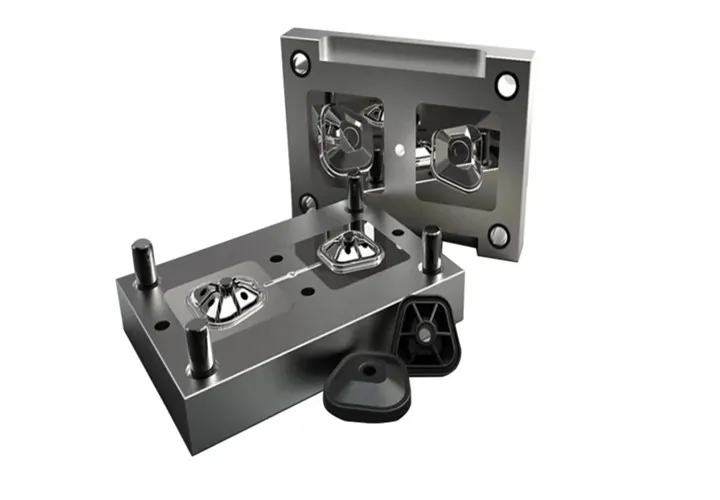
- Two – Plate Mold: A two – plate mold consists of two main parts: the cavity side and the core side. This mold type is simple and cost – effective, making it suitable for parts with basic geometry.
- Three – Plate Mold: A three – plate mold features an additional plate that enables better control of the injection system and can improve material flow, especially for more complex geometries.
- Hot Runner Systems: Hot runner systems maintain the plastic material in a heated state within the runner, reducing waste and enhancing efficiency, particularly in high – volume production.
When considering Acetal and Delrin, their distinct properties result in different behaviors within these mold types. Delrin, due to its flowability and mechanical properties, is particularly well – suited to three – plate mold designs, where precise control of material flow is crucial.
Two – Plate Mold vs Three – Plate Mold Design
The key structural difference between a two – plate mold and a three – plate mold is the presence of an additional plate in the latter. This extra plate allows the three – plate mold to handle more complex parts that require more precise gating and runner systems.
For Acetal, a two – plate mold design is often adequate for simpler, high – volume parts where cost – efficiency is a priority. Delrin, on the other hand, is better adapted to three – plate mold designs, as its superior flow characteristics facilitate the production of more intricate, high – precision parts.
Importance of Mold System Design for Acetal and Delrin
Both Acetal and Delrin exhibit different thermal properties and flow behaviors, which should be carefully considered when designing the mold system.
For Delrin, its flowability must be taken into account when designing the mold plates and injection channel. To avoid issues such as warping or misalignment, it’s essential to account for the material’s flow and cooling behavior. Delrin’s low friction also implies that fewer adjustments may be needed in runner injection – molding systems.
Acetal, on the other hand, experiences more shrinkage during the cooling process. To prevent defects in molded parts, this requires the implementation of precise cooling – system setups. For example, the cooling channels for Acetal might need to be more closely spaced or have a higher flow rate of the cooling medium to ensure even cooling and minimize shrinkage – related issues.
Mould Assembly Process and Tool Room Considerations
Understanding the assembly process and the tool – room requirements is vital for successful injection molding with both Acetal and Delrin.
Steps in the Mould Assembly Process
The mould – assembly process involves several key steps:
- Tooling Setup: Selecting the right mould plates and steel materials is crucial. S136H steel or its equivalent is often recommended for tooling due to its durability and wear resistance. When working with Acetal, which has a relatively higher shrinkage rate, the mold plates may need to be designed with slightly larger cavities to compensate for the shrinkage. For Delrin, considering its flowability, the surface finish of the mold plates should be carefully controlled to ensure smooth material flow.
- Alignment and Injection Channel Setup: Proper alignment of the injection channel is essential to ensure uniform material flow. This is particularly important when working with Delrin, as its more complex flow behavior compared to Acetal requires precise alignment. For Acetal, while the alignment is still critical, the injection channel may need to be designed with a slightly larger diameter to account for its lower flowability.
- Sprue Setup: The molding sprue must be carefully designed to facilitate the smooth entry of material into the cavity. For Delrin, the sprue design should consider its high – temperature flow characteristics, ensuring that the material doesn’t solidify prematurely. In the case of Acetal, the sprue should be designed to minimize shear stress on the material during injection.
Tool Room Requirements
The tool room must uphold high cleanliness standards and precise tolerance control. For both Acetal and Delrin, mold – cooling systems need to be meticulously designed to accommodate the materials’ unique thermal properties.
For Delrin, special attention must be paid to cooling channels to prevent overheating, which could lead to distortion. The cooling channels for Delrin should be designed with a larger cross – sectional area and a more efficient cooling – medium flow rate to dissipate heat effectively. Acetal, with its higher shrinkage rate, may require modifications to the cooling system, such as using a variable – temperature cooling strategy. This could involve initially cooling the part more rapidly to reduce shrinkage and then gradually decreasing the cooling rate to prevent internal stresses.

Injection Molding Challenges: Undercuts, Shrinkage & Ribs
Injection Molding Undercuts
An undercut in plastic design refers to a feature where part geometry prevents easy ejection from the mold. Undercut injection molding often requires additional components like lifters or collapsible cores to release the part.
Delrin excels in undercut molding because of its superior strength and flowability. It can more easily manage the complex geometries associated with undercut plastic injection molding. In contrast, Acetal may require more specialized tools due to its relatively lower strength and flowability in such scenarios. For example, when using Acetal for undercut parts, the lifters or collapsible cores may need to be designed with a more robust structure to ensure proper part release.
Plastic Rib Design & Hole – Through Features
When designing parts with plastic ribs, it’s necessary to consider how the ribs will affect the flow and structural integrity. Both Acetal and Delrin can handle rib design, but Delrin’s better mechanical strength ensures fewer weaknesses in the final part. When designing hole – through features in either Acetal or Delrin, care should be taken to avoid creating stress concentrations that may lead to weak points. For Acetal, due to its lower strength, it may be necessary to use fillets or chamfers around the holes to reduce stress concentrations. In the case of Delrin, while it has higher strength, the hole – through features should still be designed with precision to maintain the overall integrity of the part.
Shrinkage Control
Both materials experience shrinkage during cooling, but Delrin generally offers better shrinkage control than Acetal. Managing shrinkage is especially crucial when working with thin – walled parts or parts with high – precision requirements. For thin – walled parts made of Acetal, the cooling process may need to be more closely monitored and controlled. This could involve using a cooling medium with a more stable temperature and adjusting the cooling time based on the part’s dimensions. In contrast, Delrin’s better shrinkage control allows for more consistent production of thin – walled parts, but still requires careful attention to ensure dimensional accuracy.
Injection Molding Process Optimization
Optimizing the injection molding process is essential for the production of high – quality parts. In this section, we’ll cover some essential factors for Delrin and Acetal molding.
Ejection Force Calculation and Part Release
The ejection force calculation depends on factors such as material stiffness, surface finish, and part geometry. Assuming the same surface finish and part geometry, Delrin, with its higher mechanical strength, typically has higher ejection – force requirements. Acetal, being less dense, may require less force for ejection. However, Acetal also has a higher tendency to warp, which must be considered in the ejection design. To mitigate warping during ejection, the ejection pins for Acetal parts may need to be more evenly distributed or have a larger contact area with the part.
Calculating Regrind Percentage
Both materials can be recycled, but high regrind percentages can affect their mechanical properties, especially in Delrin. Acetal is more tolerant of regrind. To calculate the regrind percentage, you can use the formula: (Weight of regrind material / Total weight of material used) × 100. However, when using Acetal, it’s important to note that excessive regrind can lead to part inconsistencies, particularly with critical features. For Delrin, it’s advisable to limit the regrind percentage to maintain its superior mechanical properties. A common guideline is to keep the regrind percentage for Delrin below 20%, while Acetal can tolerate up to 30 – 40% depending on the application.
Application – Specific Suitability
Certain applications demand specific properties that make Delrin or Acetal the better choice.
Injection Molding Tubes and Thin – Walled Parts
When producing injection – molding tubes or thin – walled parts, Delrin is often the preferred material. Its superior mechanical properties, such as high strength and dimensional stability, make it ideal for creating precise and durable parts where dimensional stability is crucial. In the case of thin – walled tubes, Delrin can better withstand internal and external pressures without deformation.
Undercut – Rich Parts and Complex Geometries
For parts with complex undercut designs, Delrin’s undercut plastic injection – molding capabilities shine. It can maintain its strength and precision in intricate mold designs, reducing the need for additional mold components. For example, in a multi – cavity mold with complex undercut features, Delrin can be molded with fewer issues related to part distortion or incomplete filling compared to Acetal.
Long – Term Durability and Wear
Both Acetal and Delrin exhibit excellent durability, but their long – term performance varies.
Mechanical Stress and Fatigue
Delrin, with its superior fatigue resistance, is often the material of choice for dynamic components that experience repeated stress. Acetal is less resistant to fatigue but still performs well in less demanding applications. For example, in a conveyor – belt pulley, Delrin would be a better option as it can withstand the continuous stress of rotation over a long period. In contrast, Acetal could be used in a pulley for a less – frequently used, low – load conveyor system.
Environmental Resistance
Both materials offer good environmental resistance, but Delrin outperforms Acetal in high – temperature environments. Acetal can suffer from moisture absorption, which may impact its performance in certain conditions. In a high – humidity industrial environment, Delrin – made components would maintain their dimensional stability and mechanical properties better than those made of Acetal.
Which to Choose: Acetal or Delrin for Injection Molding?
Choosing between Acetal and Delrin depends on several factors, including:
• Budget: Acetal is generally less expensive, making it a cost – effective option for applications where budget constraints are significant.
• Precision and Tolerance: Delrin is better suited for high – precision applications due to its superior mechanical properties and better shrinkage control.
• Mold Type: Delrin is more appropriate for complex molds, while Acetal is ideal for simpler molds.
Here’s a summary comparison:
| Feature | Acetal | Delrin |
| Strength | Good | Excellent |
| Shrinkage Control | Moderate | Better |
| Suitability for Undercuts | Average | Excellent |
| Recyclability | Good | Moderate |
| Best for | Simple molds | Complex molds, high precision |
Conclusion: Acetal vs Delrin – Which Wins in Injection Molding?
Both Acetal and Delrin have their advantages, and the choice of the right material depends on your project requirements. For simpler molds, Acetal might be the optimal choice, while for more complex, high – precision parts, Delrin stands out. By understanding the unique properties of these materials, you’ll be able to make an informed decision on which material best fits your specific injection – molding needs.
FAQs
- What is undercut in plastic design and how does Delrin handle it better?
◦ Undercut refers to part features that prevent simple ejection. Delrin, with its better mechanical strength and flowability, can more effectively handle undercut plastic injection molding. Its ability to maintain its shape during the molding process and withstand the forces required for part release in complex geometries gives it an edge over Acetal.
- Which types of injection molds are best for Acetal?
◦ Acetal is best used in two – plate molds for simpler parts with basic geometries. These molds offer a cost – effective solution for high – volume production of Acetal parts, taking advantage of Acetal’s relatively straightforward processing requirements.
- How to calculate ejection force for Acetal vs Delrin?
◦ The ejection force calculation depends on material stiffness, surface finish, and part geometry. Assuming the same surface finish and part geometry, Delrin, with its higher mechanical strength, generally requires a higher ejection force compared to Acetal. However, Acetal’s tendency to warp must also be considered in the ejection design.
- Why is mold cooling design crucial for Delrin injection molding?
◦ Delrin has unique thermal properties. If not cooled properly, it can overheat, leading to distortion. A well – designed mold – cooling system for Delrin helps maintain its dimensional stability and ensures the quality of the molded parts.
- Can I use high regrind percentages with Acetal?
◦ Yes, Acetal is more tolerant of regrind materials. However, excessive use can affect the consistency of molded parts, especially in critical features. It’s advisable to limit the regrind percentage to maintain part quality.
- What makes Delrin better for two – plate injection mold applications?
◦ Delrin’s superior strength, wear resistance, and flowability make it well – suited for two – plate injection molds, especially for precise and high – precision parts. Its properties allow for better control of material flow and part formation in the relatively simple two – plate mold design.